

Love — Forever Changes (1967)
The Album That Taught Me to Hear the Mismatch

I first found Forever Changes in 1994 through Colin Larkin’s All Time Top 1000 Albums. Not through radio, not through some older collector guiding me into the secret canon, and not because Love were already part of my musical vocabulary. I found it in a book, which feels right for that period of my life. I was looking for maps then. Musical maps, intellectual maps, personal maps. Anything that might suggest a route from where I was to wherever I was supposed to go next.
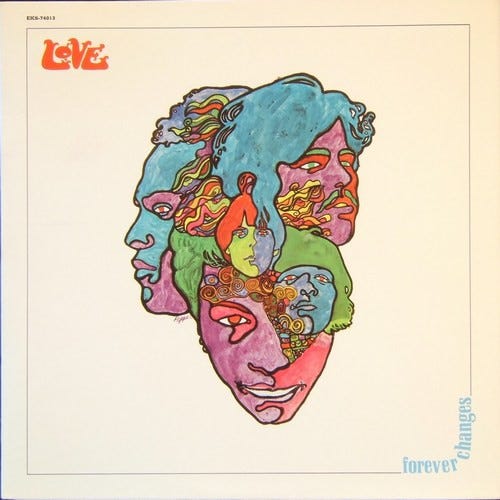
The line that caught me was the suggestion, as I remember carrying it, that Forever Changes might be the greatest album ever made that had still sold fewer than a million copies. Whether I remembered the wording exactly hardly matters now. What mattered was the implication. Here was a record being described as major, beautiful, and somehow still under-recognized by the larger machinery of success.
At that age, that idea had force. The world did not always measure value correctly. The most important signals were not always the loudest ones.
I had left home at eighteen for Leicester to study electronics. For a time, that seemed like the path. Then it became clear, through a mixture of circumstance, fit, and hard practical reality, that electronics was not going to be my future in the way I had imagined. That is a difficult thing to admit when you are young, because changing direction can feel like evidence against you. It can feel as though the system has returned a failure reading and stamped it permanently on your record.
But it was not permanent. It was data.
By 1994 I was rebuilding through technical college, trying to get the grades and foundations necessary to move toward physics. Some of that period was spent back around Teignmouth, some of it not. The geography was less important than the condition. I was between versions of myself: not the person I had expected to become at eighteen, and not yet the person who would eventually read physics at university. I was learning that potential meant very little until it was converted into work. I was learning that being bright could open a door, but it would not walk through it for you.
That was one of the home truths of that period. Intelligence was useful, but it was not sufficient. It could give you speed, but not endurance. It could help you see a problem, but not necessarily carry you through the long, repetitive discipline required to solve it. If I was going to build the next phase of my life, it would require effort, help, humility, and luck. Needing those things was not a personal defect. It was part of the operating reality.
That is the condition in which Forever Changes entered my life.
I bought it at the first opportunity. For once, this was money well spent.
I did not understand the record immediately. That would make the story too neat. What happened was stranger and more important: I could feel that it was operating at a level I had not yet learned how to describe. I was used to music affecting me through melody, atmosphere, energy, or identity. Forever Changes did something else. It made me listen for contradiction.
The surface was beautiful. Acoustic guitars, strings, brass, vocal harmonies, melodies moving in that strange Los Angeles light. Yet the emotional information underneath kept pulling in another direction. The arrangements seemed to rise; the lyrics kept detecting damage below the floorboards. The music opened the windows while the words checked the locks.
That mismatch became the key.
Today, I would describe it as a phase problem, though not in the narrow technical sense of a recording error. The album runs two signals together that are deliberately imperfectly aligned: chamber-pop elegance and psychological alarm. When those signals reinforce each other, the songs glow. When they pull apart, the glow becomes unstable. Much of the album’s power lives in that interference pattern.
David Angel’s orchestrations are central to this. They do not simply decorate Arthur Lee’s songs. They create a counterforce. The strings and horns often behave as if form, proportion, and continuity remain available. Lee’s writing keeps registering fracture, suspicion, mortality, and social breakdown. The result is beauty placed under diagnostic load.
That reached me before I could explain why.
At twenty-something, trying to redirect my life, I was starting to understand that outward coherence and inward alignment are not the same thing. A person can appear capable while privately recalibrating almost everything. A plan can look sensible until experience proves that its assumptions were wrong. A life can continue to function while the meaning underneath it has begun to drift.
Forever Changes sounded like that condition.
This is why I resist calling it simply the perfect hippie album. The phrase is tempting because the record has so many of the period’s surface markers: flowers, acoustic textures, orchestral color, strange turns of language, the afterimage of communal possibility. But the album does not perfect the dream. It records the dream at the point where it starts to hear its own structural failure.
Love understood why the dream mattered: freedom, imagination, love, beauty, escape from dead social forms, the possibility of making a different kind of life. But they also heard what was already moving underneath it: fear, performance, violence, ego, isolation, and the market’s ability to turn liberation into style. The album is not anti-idealism. It is idealism with a working fault detector.
That may be why it reached me so deeply in 1994. I was not looking for a museum piece from 1967. I was looking for something that could help me think. I did not need an album to tell me everything would be fine. I needed one that could make confusion legible without falsifying it.
Forever Changes did that by teaching me how to hear a split signal.
“Alone Again Or” sounded warm, but the warmth carried abandonment. “A House Is Not a Motel” began with architecture and ended with voltage. “The Red Telephone” used the sound of collective speech to make freedom feel enclosed. Over and over, the album made the same demand: do not stop at the surface. Listen to the relationship between what is being said and how it is being carried.
Before this, I had loved albums. With Forever Changes, I began trying to read one. Not academically, and not with the confidence I would later develop as a writer. More like someone trying to understand why a circuit behaves differently under load. I did not yet have the vocabulary, but I had begun to sense the method. The album was not only giving me songs; it was training attention.
That training mattered because my own life was becoming an exercise in revised measurement. I had thought one path would lead somewhere. It did not. That did not mean the effort was wasted. It meant the reading had changed. Electronics had not become my future, but the discipline of trying, failing, redirecting, and rebuilding became part of the route to physics. The failed path still supplied information. It still shaped the person doing the next piece of work.
That is one reason Forever Changes has never felt like nostalgia to me. It is tied to a very specific moment in my life, but it does not remain trapped there. It continues to function because its central mechanism is still active. Surface and structure remain in tension. Beauty remains unreliable as reassurance. The record still asks whether the thing that sounds stable is actually stable, whether the thing that looks like freedom is actually free, whether the thing called love can survive contact with knowledge.
The title contains the whole problem. Forever Changes. Two words pushing against each other. “Forever” promises permanence. “Changes” removes the guarantee. The album does not resolve that contradiction. It teaches you how to live inside it.
In 1994, that was not an abstract lesson. I was trying to find permanent values inside changing circumstances. I was learning that success could not be measured only by money, status, or the appearance of control. I was beginning to understand that a meaningful life required better instruments: attention, work, collaboration, correction, and the willingness to accept help without treating it as humiliation.
Forever Changes did not give me those instruments fully formed.
It made me want to build them.
And that is why the album still sits near the beginning of my real listening life. Not because it was the first record I loved, but because it was one of the first that made me aware of listening as an act of analysis. It showed me that an album could be a system. It could carry contradiction without collapsing. It could expose the difference between a clean surface and a true reading.
For a young man trying to reroute his life, that was more than beautiful.
It was the start of a method.
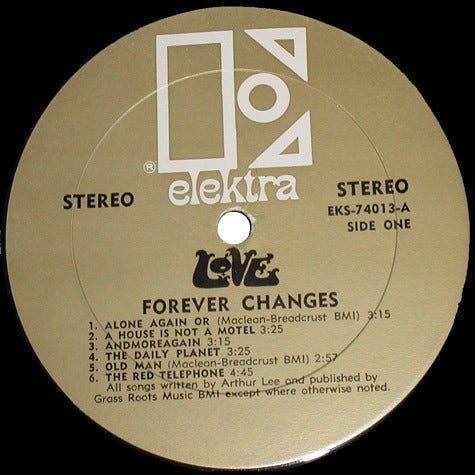
Side One: Private Assumptions Under Load
The opening side of Forever Changes teaches you how to hear the album.
It does not announce itself as darkness. It does something more effective. It makes instability sound civilized. The guitars are warm. The brass glows. The arrangements have poise. Yet almost every song carries a second current underneath the surface, and that second current keeps disturbing the first.
This was what caught me before I knew how to name it. The album sounded beautiful, but I could not relax inside it. Every time the music seemed to offer reassurance, the lyric shifted the ground. It was like walking through a carefully lit house and slowly realizing the foundation had moved.
“Alone Again Or”
“Alone Again Or” is a perfect opening because it gives the listener pleasure before it gives the listener certainty.
The acoustic guitar moves with Spanish-flavored lift. The trumpet gives the song that burnished, late-afternoon quality. Bryan MacLean’s melody is immediate in the way only truly durable melodies are: it feels less written than uncovered.
But the title is already unstable.
“Alone again” would be direct. The added “or” leaves the emotional state unresolved, almost conditional. It suggests loneliness as something waiting at the edge of every human arrangement. You might not be alone now. You may not be alone later. Or you might be alone again, because that is the reading the system keeps returning.
The song’s generosity is part of its ache. There is no rage in it. No grand accusation. It has the sound of someone trying to behave beautifully in the presence of disappointment. That is far more adult than bitterness. Bitterness still believes it has a claim on the world. This song sounds like someone who has begun to understand the limits of that claim.
For me in 1994, that was one of the first measurements the album took. It showed that sadness does not always deform the surface. Sometimes it continues with posture, melody, and manners. The emotional damage is present, but the form holds.
“A House Is Not a Motel”
The second track changes the pressure.
“A House Is Not a Motel” brings Arthur Lee fully into the center of the album. The music sharpens. The guitars bite harder. The vocal carries authority, but also alarm. The chamber surface has not disappeared, but electricity begins pushing through it.
The title is architectural and psychological at the same time. A house suggests shelter, history, continuity, belonging. A motel suggests transit, temporary occupation, a room that has no obligation to remember you. Lee places those ideas beside each other and lets the distinction become uncertain.
That uncertainty would have reached me strongly during the period when I first heard the album. Home was not a simple idea then. I had left, tried a path, discovered it was not going to hold, and was trying to redirect myself without turning that redirection into defeat. Returning to familiar places can help you rebuild, but it can also tempt you to remain inside an older version of yourself. A house can protect you. It can also delay you.
The song expands that private instability into something wider. Domestic space, violence, history, and social pressure begin to occupy the same field. The room is not sealed from the world. The larger culture enters through the walls.
By the time the guitars at the end begin to tear across the arrangement, the album has made its second major move. Beauty has been tested against home, and home has failed as a simple category. Shelter is no longer guaranteed by structure. You have to ask what kind of life is being lived inside the walls.
“Andmoreagain” and “Old Man”
“Andmoreagain” and “Old Man” form the vulnerable interior of side one. They are softer songs, but the softness does not reduce the pressure. It refines it.
“Andmoreagain” is almost weightless. The melody drifts, and the title has the circular logic of need: and more, again. Desire repeats. Affection returns. The person keeps circling the same emotional source because absence is worse than uncertainty.
The orchestration here is so delicate that it almost hides the instability of the feeling underneath. Almost. The song does not explain vulnerability; it creates a space where vulnerability can be heard without defense. That was new to me. I had known songs that declared sadness, longing, or love. This seemed to behave like the feeling itself, moving without a fixed edge.
“Old Man” approaches the same interior space through the idea of wisdom. When I first heard it, I responded to the longing for guidance. I was at exactly the age and condition where the idea of an older figure, someone who understood the road ahead, had real emotional force. I wanted life to contain that kind of voice: calm, experienced, generous, able to make confusion smaller.
The song is wiser than that fantasy. It does not deliver instruction. It creates the ache for instruction.
Hearing it now, I recognize something more practical in it. Experience does not remove uncertainty. It changes your tolerance for uncertainty and teaches you to separate useful discomfort from warning signs. At twenty-something, uncertainty can feel like proof that you have taken a wrong turn. Later, you begin to learn that some uncertainty belongs to growth, some to denial, and some to a system that genuinely needs correction.
That distinction was forming in me when I discovered the album. I was beginning to understand that changing direction from electronics toward physics did not mean the earlier path was meaningless. It meant the earlier reading had been updated. The system had returned new information. The task was not to mourn the first plan forever, but to use what it had taught me.
“Andmoreagain” and “Old Man” do not push the album into crisis. They measure sensitivity. They show how little force is required to reveal instability when the emotional material is already under tension.
“The Daily Planet”
“The Daily Planet” brings the public world back into the album.
The title suggests information, newspapers, daily circulation, the machinery by which a society narrates itself. But the song does not feel confident in that machinery. It feels busy, bright, and slightly fractured. People move through it as if normality is a performance they have learned well enough to repeat.
Lee’s observational position is crucial. He sounds close enough to the scene to understand its attraction, but far enough outside it to detect the emptiness in some of its gestures. That double position gives Love much of their authority. They are not tourists in the dream. They are residents inspecting the wiring.
This track also helped me hear something I would later recognize in many other systems. Activity can look like health. Forms can be completed. People can appear purposeful. The language can sound correct. But movement is not direction, and a functioning surface does not prove a healthy system.
In 1994, I did not have a professional vocabulary for that. I did not yet think in terms of quality systems, failure modes, or calibration drift. But the emotional principle was already becoming visible. You could build an outwardly convincing life around assumptions that no longer held. You could perform the expected version of yourself while the real work waited elsewhere.
“The Daily Planet” catches that social performance in miniature. It sounds lively, but the liveliness is under inspection.
“The Red Telephone”
“The Red Telephone” is where side one reaches its most disturbing measurement.
The song slows the album down and gives it ceremonial weight. The arrangement feels deliberate, almost fragile in its grandeur. Yet the emotional space tightens as the song proceeds. The result is one of the clearest examples of the album’s split signal: formal beauty carrying existential pressure.
The lyric moves toward confinement, fear, judgment, and the strange condition of being trapped inside a culture that still speaks in the language of freedom. This is where the album’s 1967 setting remains relevant without becoming trapped in period costume. Societies often preserve the words after the condition has weakened. They keep saying freedom, love, community, peace, progress, while the lived experience of those values becomes narrower and more controlled.
The ending is devastating because the group voice should feel liberating. In ordinary musical grammar, voices joined together suggest solidarity or release. Here, the opposite occurs. The chant sounds enclosed, almost programmed. The community voice becomes another room with no exit.
That was one of the moments that disturbed me most when I first listened. I did not parse it neatly. I just knew something had inverted. The sound of togetherness had stopped feeling safe.
By the end of side one, the album has performed a sequence of tests.
Love is tested by absence. Home is tested by violence. Tenderness is tested by recurrence. Wisdom is tested by youth. Public life is tested by performance. Freedom is tested by repetition.
That is the architecture of the side. Six songs, each applying pressure to a human assumption and listening for drift. The arrangements are not decoration around those tests. They are part of the test apparatus. They make the surface attractive enough that the contradiction has somewhere to register.
This is why Forever Changes changed my listening life. It moved me from asking whether a song was beautiful to asking what that beauty was doing. Whether it was revealing or concealing. Whether it was aligned with the lyric, or carrying a different reading altogether.
For someone trying to rebuild a life from a changed set of assumptions, those were not merely musical questions. They were practical ones.
Side two then moves the same method outward. The private rooms of side one give way to street, scene, season, and civic voltage. The album keeps its beauty, but the scale of the mismatch grows.
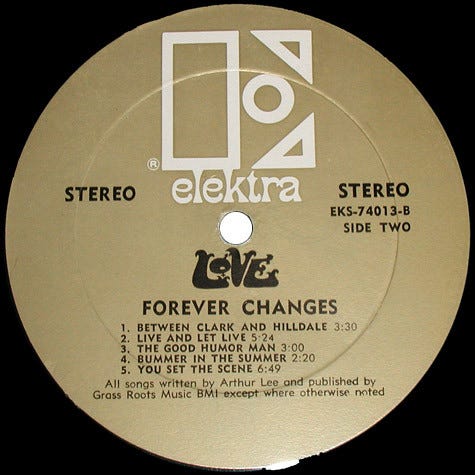
Side Two: The Public Dream Under Voltage
Side two widens the field.
The first side of Forever Changes tests private assumptions: love, home, tenderness, wisdom, speech, freedom. The second side moves those pressures outward into the street. The rooms are still there, but now the city enters the measurement. The album begins to ask whether the larger dream surrounding these people is any more stable than the private lives inside it.
This is where Love become more than a band making beautifully uneasy songs. They become witnesses to a culture already drifting away from the language it uses to describe itself. The music still carries the colors of 1967: light, movement, ornament, possibility. But the payload underneath is more suspicious. The public dream is running hot, and the album keeps listening for where the insulation starts to fail.
“Maybe the People Would Be the Times or Between Clark and Hilldale”
The title sounds playful until you stay with it for a moment. “Maybe the people would be the times” is almost a thesis disguised as a shrug. Are people shaping the moment, or are they simply the moment made visible? Are the clothes, faces, gestures, and street rituals expressions of freedom, or evidence of a culture learning how to perform itself?
“Between Clark and Hilldale” brings the question down from philosophy into geography. This is not an abstract scene. It is Los Angeles as lived territory: sidewalks, clubs, glances, coded movement, the social electricity of people wanting to be seen and wanting to belong.
The music has brightness and motion, but Lee’s perspective is never simply celebratory. He sounds close enough to understand the attraction and far enough away to distrust the performance. That double position is one of Love’s strengths. They are inside the dream and already auditing it.
For me, this connected with a lesson I was beginning to learn in my own life. Belonging and direction can look similar from the outside. So can activity and progress. You can be around the right people, moving through the right places, saying the right things, and still not be moving toward anything solid. The album hears that distinction. The street is alive, but the life in it is being questioned.
“Live and Let Live” / “Bummer in the Summer”
“Live and Let Live” raises the voltage.
The phrase itself sounds easy, almost harmless. It belongs to the language of tolerance: let people be, do not interfere, allow freedom its natural range. But the song does not allow the phrase to remain comfortable. It pushes the slogan into human behavior, where all slogans either become real or collapse.
The arrangement has forward pressure. The beauty remains, but it no longer floats. It moves with nervous energy, as if the song is testing whether the ideal can survive contact with people as they actually are: vain, frightened, generous, cruel, inconsistent, capable of love and capable of damage.
That is where the album’s idealism becomes adult. Values do not mean much when conditions are easy. Freedom becomes real when someone else uses it differently than you would. Love becomes real when it stops being self-flattering. Community becomes real when it requires inconvenience.
“Bummer in the Summer” gives the same problem a shorter, rougher form. The song is almost brusque after so much elegance, and the album needs that abrasion. It throws dust on the polished surface. Summer should be the season of release, heat, youth, bodies, possibility. A bummer in the summer means the dream has failed at the exact moment it was supposed to bloom.
This is not retrospective disillusionment. Love are hearing the fracture while the party is still going on.
Together, these two songs examine the gap between public language and lived result. “Live and Let Live” tests the slogan. “Bummer in the Summer” measures the residue. The conclusion is not that freedom, love, or community are false. The conclusion is that they are fragile under load and easily counterfeited by style.
That remains one of the album’s most modern qualities. We still live in systems fluent in the vocabulary of virtue and often weaker in the practice of it. We declare values faster than we embody them. Forever Changes was already listening for that separation.
“The Good Humor Man He Sees Everything Like This”
“The Good Humor Man” seems, at first, like relief.
The arrangement floats. The title suggests sweetness, childhood, maybe even innocence. But by this point in the album, sweetness has become complicated. We have learned to ask what beauty is doing before accepting what beauty appears to offer.
The Good Humor Man sees everything “like this.” The phrase is beautifully ambiguous. Is he blessed with a gentler vision, or protected by a narrowed one? Does he see clearly and choose kindness, or does he soften the world because the harder outline would demand too much?
The song does not answer cleanly. It suspends the question inside one of the album’s most delicate arrangements. That is the point. The music gives us a softened lens, but the album has already trained us to inspect the lens itself.
This is a small song with large implications. It knows that gentleness can be grace, but it can also be evasion. It knows that innocence may be beautiful without being adequate. On an album this alert to fracture, even sweetness has to be tested.
“You Set the Scene”
Then comes the closing measurement.
“You Set the Scene” is the album’s great final argument because it does not merely gather the themes together. It changes the level of the problem. Until now, Forever Changes has exposed mismatches: between beauty and dread, house and home, freedom and repetition, social life and performance, dream and evidence. The closing track asks what remains possible after those readings have been taken.
The song moves in sections, and that structure is essential. It feels like thought under construction. A single declarative ending would have been false to the album’s method. Instead, the track advances by adjustment: tenderness, doubt, reflection, expansion. It does not return innocence to the system. It looks for usable orientation after innocence has gone.
That is why this song landed so deeply for me, even before I fully understood it. In 1994, I was trying to move from a failed or at least exhausted direction into a new one. Electronics had not become the future I had imagined, but the effort was not wasted. It had taught me how plans fail, how assumptions get revised, and how humiliation can be converted into information if you do not let pride destroy the evidence.
“You Set the Scene” speaks to that kind of redirection. The world will not organize itself around your preferred story. People will disappoint you. You will misread yourself. The measurements you trusted at eighteen may not hold at twenty, thirty, or fifty. But the collapse of one reading is not the end of measurement. It is the beginning of a more honest one.
This is where the title finally completes its work. Forever Changes is not only a statement about impermanence. It is a recognition that permanence, if it exists at all, must survive alteration. The things that matter cannot be proven by remaining untouched. They are proven by what they can carry through change.
Love, work, friendship, ambition, discipline, community — all of them sound stable until life applies pressure. Then you find out whether they were values or slogans. You find out whether success means public measurement only, or whether it also includes the quieter capacity to accept help without turning it into shame, and to offer help without turning it into power.
That was the lesson I needed.
The world is very good at judging success by money, position, status, and volume. Those are easy numbers to read. They are not meaningless, but they are incomplete. Forever Changes helped me hear that incompleteness before I had a fully formed language for it.
That is why the album stood up for me in the mid-90s, and why it stands up now. It did not give me comfort in any simple sense. It gave me a better instrument. It taught me to listen when the surface and the structure disagreed. It showed me that beauty could carry warning, that disillusionment did not have to become cynicism, and that a failed dream could still leave behind usable truth.
Many records remain powerful because they preserve the listener’s past. This one does something more demanding. It keeps changing as the listener changes. At twenty-something, I heard guidance. Later, I heard diagnosis. Now I hear calibration: the ongoing work of testing one’s life against the evidence and adjusting without losing the deeper signal.
That is why I still return to it.
Forever Changes is not just one of the great albums of 1967. It is one of the great albums about what happens when the dream, the self, and the surrounding world fall slightly out of alignment — and the listener has to decide whether to ignore the interference or learn from it.
For me, it was one of the first records that made learning possible.
Not by explaining the world.
By teaching me how to hear when the world and its promises no longer matched.
Further Listening
These are not soundalikes. Very little truly sounds like Forever Changes. These are neighboring records: albums where beauty, ambition, cultural pressure, and instability move through the same system at different rates.
The Byrds — Younger Than Yesterday
A key Los Angeles companion. The harmonies remain bright, but the innocence has begun to thin. The Byrds show folk-rock becoming sharper, stranger, and more self-aware. Like Love, they understand that polish can hide drift.
Buffalo Springfield — Buffalo Springfield Again
A record full of talent pulling in multiple directions at once. It shares with Forever Changes the feeling of a band briefly held inside the same frame before internal force starts pushing the frame apart. Less haunted than Love, but similarly charged by possibility and instability.
The Doors — Strange Days
The darker Los Angeles mirror. Where Love carry unease through acoustic beauty and orchestral lift, The Doors use theatre, shadow, and urban dread. Both albums hear Los Angeles as more than sunshine. It is performance, danger, psychic heat, and surveillance.
Moby Grape — Moby Grape
One of the great “what might have been” albums of the period. More direct and muscular than Love, but valuable because it captures brilliance under unstable conditions. The songs are immediate; the surrounding story already feels precarious.
The Zombies — Odessey and Oracle
The English chamber-pop cousin. More formal, more autumnal, and less street-level than Love, but it shares that feeling of sunlight passing through cracked glass. The arrangements are exquisite, but the emotional weather underneath is far from simple.
The Millennium — Begin
The more polished Los Angeles dream. Begin is useful because it shows what happens when late-60s pop is engineered into luminous architecture. Compared with Love, it is cleaner, smoother, and less dangerous — which makes the contrast revealing.
Tim Buckley — Goodbye and Hello
Another 1967 album where folk-based songwriting stretches toward something larger and more psychologically ambitious. Buckley’s language is different from Arthur Lee’s, but both records test how much cultural and spiritual pressure a song can carry.
Spirit — Spirit
A natural next stop for Los Angeles music that refuses simple categorization. Jazz touches, rock structure, odd angles, and a sense of freedom held inside discipline. Less baroque than Love, but built from a similar refusal to behave like one genre.
The United States of America — The United States of America
For the more experimental edge of the same pressure field. This is psychedelia processed through machinery, politics, electronics, and disorientation. Less intimate than Forever Changes, but useful for hearing how quickly the dream could become technological and unstable.
The West Coast Pop Art Experimental Band — Part One
A more damaged mirror of the Los Angeles scene. Love convert unease into elegance; The West Coast Pop Art Experimental Band often leave the unease exposed. This helps reveal how unusual Love’s balance really was.
Van Dyke Parks — Song Cycle
A dense, ornate, and deeply constructed Los Angeles artifact. It belongs here because arrangement is not decoration; it is argument. Parks takes the studio and turns it into a thinking machine. Love do something more emotionally direct, but both records depend on arrangement as meaning.
Nick Drake — Five Leaves Left
Not Los Angeles, and not psychedelic in the same way, but essential as a later example of acoustic beauty carrying more emotional weight than its surface suggests. If Forever Changes helped teach me that gentle music could be structurally unsettling, Nick Drake made that lesson unavoidable.
Scott Walker — Scott 3
For orchestral ambition, emotional distance, and beauty placed under pressure. Walker’s world is more European and cinematic, but he shares Arthur Lee’s ability to set troubling observations inside arrangements of extraordinary grace.
Further Reading
Andrew Hultkrans — Love’s Forever Changes
The direct album study and still one of the essential entry points. Useful for placing the record inside its mythology, cultural moment, and long afterlife. Especially valuable because Forever Changes is one of those albums whose reputation grew through listeners, critics, and obsessives rather than through simple commercial conquest.
John Einarson — Forever Changes: Arthur Lee and the Book of Love
The key Arthur Lee and Love biography. This is the book for the human instability behind the work: Lee’s brilliance, charisma, contradictions, isolation, and difficulty. It makes the album more understandable without making it less strange.
Jac Holzman and Gavan Daws — Follow the Music
Important for understanding Elektra as more than a label name on the sleeve. Holzman’s role matters because Forever Changes sits at the point where Elektra’s folk-rooted seriousness met the ambition and volatility of rock culture.
Barney Hoskyns — Waiting for the Sun
A strong wider account of the Los Angeles music world that produced Love, The Doors, Buffalo Springfield, and the surrounding scene. Useful because Love should be heard both as part of that world and as a critique of it.
Michael Walker — Laurel Canyon
Good for the cultural geography: Los Angeles as myth, industry, refuge, and trap. Love are not a simple Laurel Canyon comfort story, but understanding the mythology helps clarify what Arthur Lee absorbed and what he resisted.
Domenic Priore — Riot on Sunset Strip
Useful for grounding the softer mythology of flowers, freedom, and beautiful people in the harder street-level reality of Los Angeles youth culture. Police pressure, clubs, commerce, race, fashion, and generational conflict all belong to the world Forever Changes is measuring.
Barney Hoskyns — Hotel California
Best read after Waiting for the Sun. It carries the Los Angeles story forward into the professionalized, wealthy, damaged 1970s version of the dream. In that sense, it helps explain what came after the failure signals Forever Changes was already detecting.
Colin Larkin — All Time Top 1000 Albums
This belongs here for personal reasons. For me, it was the doorway: one book, one sentence, one claim about an under-recognized masterpiece, and then the decision to go and find out whether the claim was true. In this case, it was.
Boom-bib-bip, boom-bip-bip, yeah!! They were the first REAL garage band with a black front man. Talk about racial diversity in the 60's. Unheard of in those days when it came to psychedelic rock. I was all of seven when my teenaged brothers brought that music into the house much to our dads disdain. What a fantastic flashback, Howard, thanks again.
Let me start, Howard, by saying that I was very much looking forward to your piece on this most wonderful album. I discovered it while I was responsible for catalogue at Warner Music Belgium in the early 2000s, when I released the double CD version of it. Part of my job was presenting upcoming releases to the sales team during our weekly meetings, usually in both Dutch and French, so I always had to come prepared. That preparation inevitably started with listening to the album.
At the time, I didn’t know the band or the record at all. What happened next was one of those rare musical revelations: I discovered an album that became my favorite release of that year and has remained one of my all-time favorite albums ever since.
You put it beautifully when you write that “David Angel’s orchestrations are central to this. They do not simply decorate Arthur Lee’s songs. They create a counterforce. The strings and horns often behave as if form, proportion, and continuity remain available.” That is exactly what drew me in and kept me there. The orchestrations are extraordinary.
I have always found it incredible that an album of this quality never became the universally recognized standard it deserved to be. But at the same time, there is something special about some of your greatest loves remaining slightly obscure. It makes the treasure of loving them feel even more personal and meaningful.
Your piece did a wonderful job of explaining the intricacies of the album, and I know my next listen will be even deeper because of it. I also loved the way you connected the album to your own life and to the moment you first heard it.
You are a brilliant writer, and this write-up is one of your very best. Thanks so much for sharing it.