

Joni Mitchell — Blue (1971)
The Album That Waited for Me to Grow Old Enough to Hear It

There are albums we discover, and there are albums that seem to have been waiting inside us all along.
Blue belongs to the second category for me. It was not an album I found through record collecting, critical reputation, teenage hunger, or the usual archaeology of taste. It was simply there. One of the records my mother played most often when I was a child, though “most often” needs qualification. Music from my parents was not a constant presence in the house, but a few records returned with enough regularity to become permanent: Blue, a Mamas and the Papas greatest hits album, and a Carpenters album that included “Ticket to Ride.” My sisters played music far more often — ABBA, Saturday Night Fever, Gary Numan, and the daily soundtrack of older siblings moving through rooms with their own identities already forming. But my mother’s records had a different force. They appeared less frequently, and because they appeared rarely, they carried more charge.
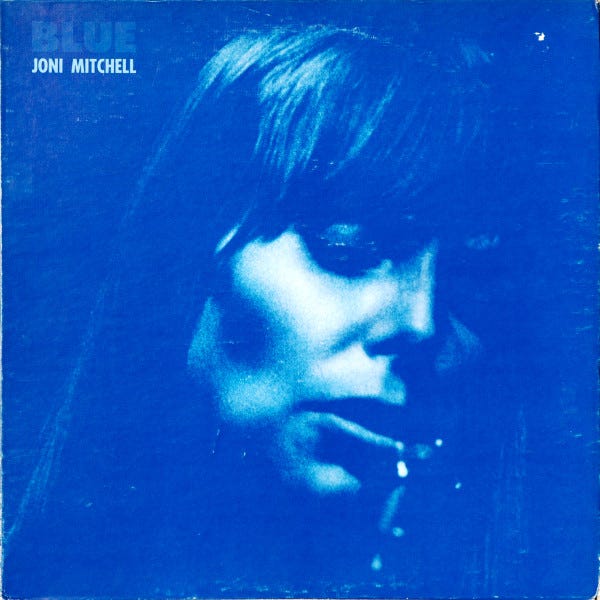
I do not remember where her copy of Blue came from. I suspect, if I were to look carefully enough, it might still be somewhere in my childhood home, tucked into whatever private archive families accidentally build and then forget they have built.
That matters because the music that enters us in childhood does not enter through the same door as music we choose later. Teenage records arrive with identity attached. They are declarations, shelters, uniforms, acts of resistance. Childhood records are different. They are environmental. They pass into the nervous system before judgment has formed. They become part of the room, part of the weather, part of the domestic air.
A single chord is enough.
Not a lyric. Not a full melody. Just one turn of piano, one dulcimer shimmer, one lift in Joni Mitchell’s voice, and the whole room returns. The house. The light. The sense of being small inside a world whose adult meanings were operating above my head. That is the strange power of records absorbed before interpretation. They are not remembered in the ordinary way. They are stored somewhere deeper than opinion.
And for years, that was how Blue existed for me.
It was etched into my soul without being understood by my mind. I knew the album intimately before I understood a single thing about it. I knew its shape, its color, its temperature. But its meanings were still sealed. Its artistry had not yet opened. It was like a nursery rhyme recited so often that the rhythm becomes comforting long before you learn that the story underneath it is darker than anyone told you.
This is not how adolescent music works. The music of one’s teenage years is discovered and then rediscovered through the development of life. You meet it first as a weapon or a shelter, then return to it later and find that it has changed because you have changed. But Blue was not like that. It was pre-discovery. It had entered before interpretation. It was already part of the internal furniture before I knew how to ask what furniture was doing in the room.
When I was twelve, both of my sisters had married and left home. After that, the music changed. The daily presence of their records disappeared, and my mother no longer seemed to play hers. The house became quieter. Not dramatically, perhaps, but meaningfully. Something in the atmosphere stilled.
Music is not just entertainment in a house. It is circulation. It moves emotional air through rooms. When it disappears, the silence is not neutral.
So Blue remained. Not as something I had chosen, but as something I had inherited without quite knowing the terms of the inheritance. Later, when I bought the album on CD, I was not discovering it in the usual sense. I was excavating it. I was recovering an object whose outline had been inside me for decades, but whose language I had never learned to read.
By my early twenties, I had a reasonable grasp of the album. I understood that it was intimate, beautifully written, and obviously deserving of its reputation. But that was not the same as hearing it. I could admire Blue before I could understand it. Admiration came first because taste is easier than recognition.
Some records require knowledge. Some require taste. Blue requires damage.
That sentence sounds severe, but I think it is true. Not damage as spectacle. Not melodrama. Not the theatrical sadness that later confessional music would so often mistake for depth. Blue requires quieter damage: the experience of loving badly, being loved incompletely, leaving when you should have stayed, staying when some part of you had already left, and watching yourself fail to become the cleaner version of yourself you once imagined.
At twenty-three, I could recognize the album’s greatness. A few years later, after clocking up a few scars, I could begin to relate to it. After more than half a century of living, I hear something different again. Not simply heartbreak. Not simply confession. I hear an album about reciprocity: the way every freedom creates a loneliness, every intimacy creates a possible wound, every act of self-definition costs somebody something, and the person who leaves is also altered by the leaving.
That is why Blue still feels dangerous.
Its softness is deceptive. The arrangements are sparse. The voice is exposed. The instrumentation leaves room around the words. But the album is not fragile in the sentimental sense. It is fragile in the engineering sense: a structure pushed close to its tolerance limits. Nothing is overloaded, yet everything is under stress. The songs hold because Mitchell knows exactly how little support they need. She removes almost every unnecessary brace, leaving the emotional load-bearing members visible.
The cover tells us this before the music begins. Tim Considine’s photograph, rendered in that saturated blue, gives us Mitchell not as celebrity but as afterimage. Face lowered, cigarette near the mouth, features partly submerged in shadow and color. She is present and disappearing at the same time. The image does not invite us toward confession in any easy way. It suggests someone passing through her own life while already half-aware that the passage itself will leave a mark.
The title does similar work. Blue is a color, a mood, a musical lineage, and a state of saturation. It is not “sad” in any simple way. Sadness is too small a word. Blue is atmosphere. Blue is the light under which every object on the album appears altered. Desire turns blue. Memory turns blue. Domesticity turns blue. Even wit and brightness are tinted by it.
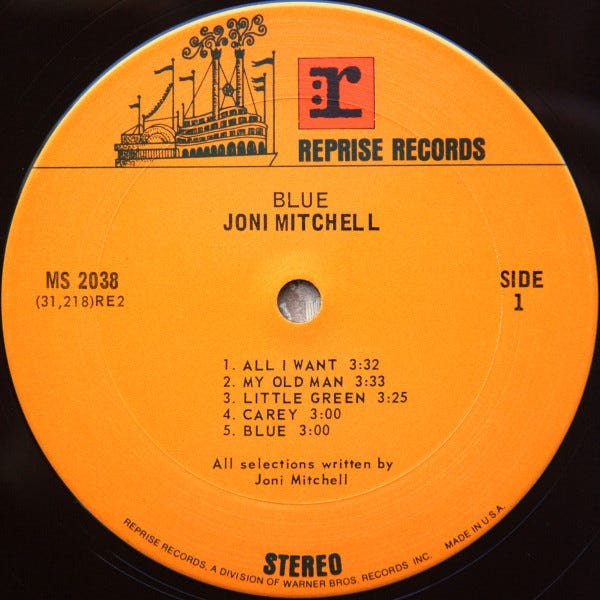
Side A: The Sound Before Meaning
The album opens with “All I Want,” and the title already contains the contradiction that governs the record. “All I want” sounds simple, almost childish. But the song immediately reveals that wanting is never simple. Wanting contains incompatible demands. Freedom and closeness. Risk and safety. Erotic charge and emotional reliability. Movement and home.
To a child, this is not yet psychology. It is motion. Brightness. The sound of grown-up feeling with air in it. Now the song is more troubling. It is not merely a declaration of desire. It is a self-diagnosis. Mitchell knows she wants too much, or at least wants in too many directions at once. She also knows that wanting less would be a kind of spiritual death.
This is where the album’s adult honesty begins. Mitchell is not only wounded by the world. She wants intensely, and that wanting creates consequences. She is not merely the one left behind; she is also the one who leaves. She is not merely injured; she can injure. She is not only seeking love; she is testing whether love can survive contact with her need for motion.
“My Old Man” moves into domestic tenderness, but domesticity does not become an answer. The song has warmth, yet the warmth is conditional. Its happiness depends on presence. Its loneliness is sharpened by absence. The piano still carries the intimacy I remember, that sense of an adult room I was too young to enter. But now I hear the vulnerability inside the arrangement. Love has not solved loneliness. It has given loneliness a more specific address.
That is one of Mitchell’s great insights on Blue: intimacy is not the opposite of loneliness. Sometimes intimacy reveals loneliness more accurately. To miss someone because you love them is not the same as being alone before love arrived. Love gives absence shape.
“Little Green” is where the childhood imprint and adult understanding collide most forcefully.
The song could pass as lullaby. The melody has that deceptive gentleness, that almost nursery-like motion. It sounds tender before it sounds devastating. But adulthood changes the receiver. Suddenly the lullaby is not simply a lullaby. It is a private document placed in public light with unbearable care. The softness is not there to soothe the wound. It is there because the subject cannot survive rough handling.
This is where Blue first reveals its delayed force. It can plant music in you before you have the equipment to understand what has been planted. Later, when life supplies the missing context, the same song begins to conduct current.
“Carey” seems to offer release. Sunlight, travel, flirtation, the temporary fantasy of being remade somewhere else. This was surely one of the bright songs to me, the one with movement and color. Now I hear something more precarious. The pleasure is real, but it is not stable. The island is not a cure. The lover is not a cure. Elsewhere is not a cure. Geography changes the lighting, but it does not erase the self.
That is one of the reasons Blue has grown larger for me with age. It understands pleasure without trusting it to save us. It allows joy to exist without forcing joy to become resolution.
Then comes “Blue,” the title track, and the album folds inward.
Everything narrows. The song feels less written than distilled. Earlier songs still move toward love, away from love, into rooms, across distance, through appetite. “Blue” sits inside the condition itself. Once, it was pure atmosphere to me — color, tone, adult sadness without explanation. Now it feels like the album’s central chamber: the point where story, memory, desire, and regret have been compressed into a single emotional state.
This is what changed with age. At twenty-three, I heard the beauty. Later, I heard the pain. Now I hear the restraint. That may be the hardest thing to recognize when you are young. Not the feeling itself, but the discipline required to hold the feeling without either decorating it or escaping it.
By the end of Side A, Blue has already established its governing truth: to feel deeply is not simply to be wounded by others. It is to become porous to the world, and to accept that everything beautiful enough to enter you may also leave a mark.
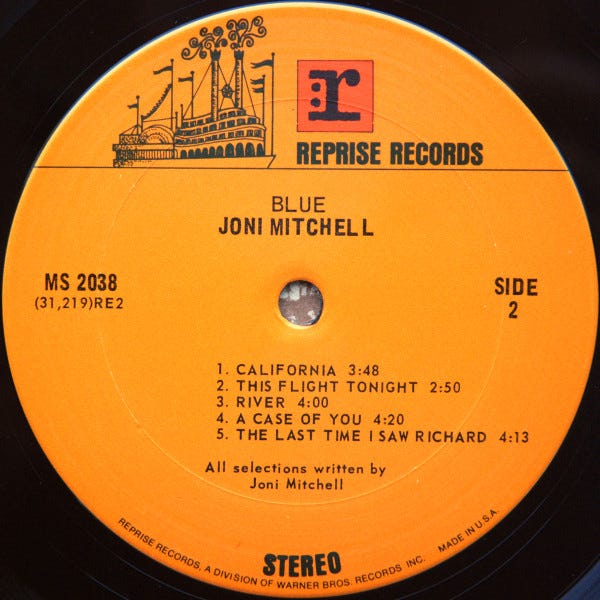
Side B: When the Adult Meaning Arrives
Side B opens with “California,” and the album appears to step back into light.
That light mattered to me before I understood anything else. The lift of the melody, the forward motion, the sense of someone writing from elsewhere and longing for return. It sounded open, more breathable than some of the songs around it. But adult listening changes the temperature. “California” is not simply a homecoming song. It is a displacement song. It is the sound of someone discovering that even pleasure can make you homesick.
That distinction matters. Mitchell is not merely saying that she misses California. She is measuring the distance between external freedom and internal rest. The song moves through travel, conversation, temporary glamour, and social performance, but beneath all of it is the ache of not quite being gathered into oneself. California becomes less a place than an imagined point of reassembly. Somewhere the scattered parts might briefly return to alignment.
Childhood hears place as literal. Adulthood learns that place is often emotional shorthand. We say we want to go back to a city, a room, a country, a person, when what we really want is the version of ourselves we remember being there. That is the deeper pull in “California.” The song is full of motion, but motion is not the same as freedom. It is someone moving through the world while trying to locate the part of herself that has not quite come along.
“This Flight Tonight” makes that problem sharper.
The title contains the album’s whole dilemma: flight as travel, flight as escape, flight as panic response. The plane has already left. The decision has already been made. The body is in motion, but the emotional self is lagging behind.
That is one of the most adult truths on Blue: feeling often arrives late.
We tend to imagine that the important emotional event happens at the moment of impact — the argument, the departure, the decision, the loss. But life often works more slowly than that. The meaning arrives afterward, sometimes hours later, sometimes years later, when the immediate logistics have already been completed and there is nothing left to do but understand what you have done.
“This Flight Tonight” lives inside that delay. It is not the drama of leaving. It is the recognition that leaving has not solved the thing that made leaving necessary. That is why the song now feels much less like escape than consequence.
“River” is probably the song most at risk of being softened by familiarity. It has become seasonal, almost absorbed into the cultural machinery of Christmas sadness. But Blue does not use winter as decoration. It uses winter as exposure. The song stands outside the season of belonging and looks through the glass.
When I was young, I heard its melancholy as beautiful and general: adult sadness, winter sadness, the kind of sadness records seemed allowed to carry in a way people in actual rooms often did not. But now the song is painfully specific. It is not only about wanting to escape. It is about wanting an escape route large enough to carry away guilt.
That is the pressure point.
Sadness can be passive. Guilt cannot. Guilt implicates the self. It changes the weight of the emotion because the wound is not only something that happened to you. It is something in which you participated. Mitchell’s honesty is that she does not make herself innocent in order to make herself sympathetic. She knows she has hurt someone. She knows the wish to skate away is impossible because the thing she wants to escape is not only the situation. It is her own part in it.
That is where Blue becomes more than an album of beautiful suffering. It refuses purified pain. Pain is mixed with appetite, error, tenderness, selfishness, pride, regret, and need. The songs are devastating because nobody is allowed the luxury of being only wounded.
“A Case of You” then arrives as the album’s most famous act of emotional concentration.
It is easy to approach it already defeated by reputation. We know we are supposed to admire it. We know it is one of the great love songs. But the song survives that burden because it is stranger than its reputation suggests. It is not simply romantic. It is absorptive.
The beloved in “A Case of You” is not merely remembered. He is taken in. He becomes part of the body’s chemistry, part of perception itself. The song’s language of drinking and containment is romantic, yes, but it is also dangerous. To love someone this way is not merely to admire them or miss them. It is to carry them internally, to have them alter the taste of the world.
What keeps the song from collapsing into dependency is Mitchell’s lucidity. She is intoxicated, but not blind. She knows the scale of the attachment. She can describe it while still being inside it. That is the extraordinary balance of the performance. It is neither surrender nor control. It is the difficult middle state in which a person can be altered by love without surrendering the right to name what is happening.
This is where age changes the hearing. A younger listener may hear the romance. An older listener hears the residue. The question is not simply whether the love continues. It is what remains after the relationship has changed form. Some people leave and are gone. Others remain as flavor, pressure, weather. “A Case of You” is about that second category.
Then comes “The Last Time I Saw Richard,” which may be the album’s most important ending because it refuses rescue.
Richard is not just a character. He is a possible future. He represents the temptation to turn disappointment into a philosophy. Romance has failed him, or he has decided it has, and he now treats belief as childishness. He is not entirely ridiculous. That is what makes the song frightening. Cynicism can look very intelligent when it has enough evidence behind it.
Once, the song sounded to me like an adult conversation happening across a table I could not see. Later, I heard it as disillusionment. Now I hear it as the album’s final moral test. Not moral in the sense of good behavior, but in the deeper sense: what kind of person does pain make you?
This is where the album’s closing force resides. After all the wanting, leaving, longing, guilt, tenderness, and memory, the real danger is not heartbreak. Heartbreak is survivable. The deeper danger is hardening. Richard has converted wound into worldview. He has mistaken scar tissue for wisdom. That is a more permanent injury than romantic failure itself.
Mitchell resists him, but she does not do so cheaply. She cannot simply dismiss him because the album has already shown us too much. Love does wound. Freedom does isolate. Intimacy does create dependency. Desire does make fools of intelligent people. Richard is not wrong about the evidence. He is wrong about what the evidence should do to the soul.
That may be the deepest adult distinction on Blue.
Innocence does not survive the album. It should not. But openness might. Not the naïve openness that believes everything can be made whole by feeling intensely enough. Something harder than that. An openness with knowledge inside it. An openness that has seen the cost and does not pretend the cost is imaginary.
This is why “The Last Time I Saw Richard” has grown in stature for me over time. When I was younger, the emotional center of the album seemed to be the title track, or “River,” or “A Case of You.” They are the obvious gravitational points. But now Richard feels like the final threshold. The question is no longer, “Can you feel this deeply?” The question is, “Can you feel this deeply and not become cruel, brittle, or closed?”
That is a much harder question.
By the end of Side B, Mitchell has not solved the contradictions she introduced at the beginning. She has intensified them. Freedom remains necessary and lonely. Love remains sustaining and dangerous. Memory remains beautiful and punitive. Travel remains escape and exposure. But the album refuses the final simplification Richard offers. It does not let disappointment become doctrine.
That refusal is the real act of courage.
Blue does not ask us to remain innocent. It asks whether we can remain open after innocence has gone.
The Record That Scarcity Made Permanent
For me, had I grown up in a home where my parents were always playing albums, Blue might have become part of a broader musical education. It might have sat beside dozens of other records, one emotional reference point among many. But because my mother’s musical appearances were so limited, every record she returned to became oversized. Each one occupied more space than a record normally would. It was not background music. It was an event that returned.
That is part of its power for me now. It is not just a record about Joni Mitchell’s exposure. It is also a record that preserves, in my own life, a narrow passage of childhood sound before the house settled into something quieter. This gives the album a double function. It contains Mitchell’s memories, longings, losses, and emotional risks. But it also contains mine, even though mine were not yet conscious enough to know they were being stored.
That is the exchange the album creates.
Blue gives itself to the listener, but the listener also deposits life inside it. Over time, the album becomes less like a fixed object and more like a shared chamber. Mitchell’s experience remains the structure, but our own experience begins to resonate within it. Childhood, family silence, early incomprehension, adult damage, return, recognition — all of these accumulate inside the same songs.
This is why Blue can be so widely loved without becoming generic. It is intensely specific, but it leaves space for the listener to become specific too.
That space is not accidental. Mitchell’s arrangements are spare not because the songs are unfinished, but because they are deliberately unshielded. There is very little between the feeling and the listener. Piano, guitar, dulcimer, voice, breath, silence. The record does not crowd its own emotional field. It allows the songs to stand close enough that the listener cannot remain entirely observational.
This is also why the album’s reputation as “confessional” can be misleading. Confession suggests release, as if the main point were to disclose private feeling. But Blue is more disciplined than that. It is not merely confession. It is shaped exposure. Mitchell does not simply open the wound. She teaches the wound to speak in form.
That distinction is everything.
A wound without form can repel the listener or demand sympathy without earning understanding. A wound given form can become transmissible. It can cross from one life into another without becoming vague. Blue does that. It does not tell us, “This is exactly what happened to me, therefore you must care.” It says something more difficult: here is what feeling does when it is allowed to remain honest without becoming shapeless.
That is why the album grows more powerful with age: not because it becomes larger, but because its discipline becomes clearer. And the older I get, the more that discipline matters.
Youth often mistakes emotional intensity for truth. It is not always wrong, but it is incomplete. Intensity may be true in the moment, but truth that lasts usually requires shape. Blue is overwhelming not because Mitchell loses control, but because she does not. She lets feeling come close to the edge, then holds it there with extraordinary precision.
That may be the album’s deepest artistic achievement. It feels exposed, but it is never careless. It feels intimate, but it is never merely private. It feels fragile, but it does not collapse. The record holds.
The child hears atmosphere.
The young adult hears romance and heartbreak.
The older listener hears consequence.
That is the progression Blue has made in my own life. It began as something I absorbed without understanding, but it has become an album that now explains why certain childhood sounds remain active long after their original context has vanished. It explains why some music can wait inside us for decades. It explains why we sometimes understand beauty first and meaning later. It explains why pain, when shaped honestly enough, can become less isolating without becoming less painful.
That is the paradox of Blue. It does not make sadness easier by softening it. It makes sadness more bearable by making it accurate.
Accuracy is its mercy.
The album does not offer rescue. It does not pretend love will not injure us, or freedom will not cost us, or memory will not return with sharpened edges. It does not let the listener hide inside innocence. But neither does it surrender to Richard’s fatal error: the idea that disappointment should mature into cynicism.
That is where the closing song becomes the album’s final warning. The danger is not simply that we suffer. The danger is that we build a permanent philosophy around suffering and mistake the resulting structure for wisdom. Richard has evidence. That is what makes him dangerous. He has seen enough to justify bitterness if bitterness is what he wants. But evidence is not destiny. The adult task is not to remain untouched. It is to remain open without lying about what openness costs.
That is where Blue still feels radical.
It does not ask us to be young forever. It does not ask us to believe in love as a clean solution. It does not ask us to pretend that all wounds educate us nobly. Some wounds merely wound. Some losses do not improve us. Some regrets stay regrettable. But the album insists that hardening is not the only available response.
There is another possibility: damaged openness.
In my own life, that has rarely looked heroic. More often it has meant the smaller, harder decision to keep returning — to people, to work, to music, to memory — when the easier option would have been to turn competence into armor and call that maturity.
That, to me, is the mature condition of Blue. Not innocence. Not purity. Not romantic rescue. Damaged openness. The capacity to know more than you once knew, to have been marked by life, and still allow beauty, memory, desire, and tenderness to enter.
Perhaps that is why a single chord can still bring the whole thing back.
Before analysis, before reputation, before biography, Blue still works at the level of recall. It brings back rooms, silences, family weather, the strange scarcity of music in a quiet house, and the long process by which a person becomes old enough to understand what they absorbed before they had language for it.
The album entered me before I could interpret it.
It waited.
And then, decades later, it began to explain itself.
Further Listening
Carole King — Tapestry A warmer and more communal companion to Blue. Where Mitchell often examines solitude under pressure, King turns private feeling into shared domestic language.
Laura Nyro — Eli and the Thirteenth Confession More urban, explosive, and rhythmically restless, but similarly committed to treating emotional intensity as musical architecture.
Judee Sill — Judee Sill A stranger, more spiritually coded form of confession, where vulnerability is filtered through devotion, myth, and harmonic complexity.
Nick Drake — Pink Moon Another record where sparseness becomes pressure. Very different in language and temperament, but equally dependent on what is left exposed.
Sandy Denny — The North Star Grassman and the Ravens British folk melancholy with a different weather system, but a comparable sense of beauty shadowed by instability.
Joni Mitchell — For the Roses The necessary next step. Less mythologized than Blue, but essential for understanding where Mitchell went once confession alone was no longer sufficient.
Further Reading
David Yaffe — Reckless Daughter: A Portrait of Joni Mitchell A useful biography for placing Blue within Mitchell’s broader artistic and personal trajectory.
Michelle Mercer — Will You Take Me As I Am: Joni Mitchell’s Blue Period Focused directly on the period around Blue, and especially useful for understanding the album’s emotional and creative environment.
Malka Marom — Joni Mitchell: In Her Own Words Valuable because Mitchell’s own reflections complicate the simplified mythology that often surrounds her work.
Ann Powers — Traveling: On the Path of Joni Mitchell A broader interpretive study of Mitchell as artist, traveler, and self-inventing figure.
Sheila Weller — Girls Like Us Best used as cultural context, placing Mitchell alongside Carole King and Carly Simon in the changing landscape of women’s songwriting.
Brilliantly put Howard. I really feel the title. There’s some things I used to hate and as time went by, it « grew » on me.
The Laurel Canyon scene is truly a fascinating music movement and Joni Mitchell is one big piece of the overall puzzle.
Love to read you!
Yet another beautiful piece Howard, thank you.
My older sister had maybe a half dozen lps when I was a child (early 1970s) that she used to play loudly in the morning before leaving the house. Blue was one of them, and due to the 'problematic' nature of our relationship and the family dynamic, I disliked that record for a long time. But, it did have a strong impact on me, and like you I eventually came back to it as an adult. (Forever Changes was another one she had too).