

Caravan — Caravan (1969)
The Calibration Before the Canterbury Machine

The First Signal
My own route into Caravan began in 2024 with Waterloo Lily, which is an odd but useful place to enter the band. It is jazzier, less cozy, and already some distance from the relaxed pastoral wit many listeners associate with their best-known work. From there I moved quickly through the rest of the catalogue by streaming, starting from the origins and then outward into the wider Canterbury scene: Soft Machine, Matching Mole, Hatfield and the North, National Health, Kevin Ayers, Egg, Gong, and the related tributaries that make the whole map feel less like a genre than an extended family of nervous systems.
That rapid immersion can be deceptive. It gives the impression that Canterbury arrived as a complete language: witty, jazz-inflected, English, eccentric, rhythmically supple, and resistant to the heavier postures of progressive rock. But when I returned to Caravan’s 1969 debut after moving through that wider field, what became clear was not how complete the language already was, but how unstable and revealing its first signal remains.
Caravan is not the finished Canterbury machine. It is the calibration run.
The components are present: organ warmth, melodic instinct, jazz motion, soft vocal blend, English absurdity, pastoral memory, and a refusal to confuse seriousness with weight. But those components are not yet perfectly matched. The gain stages are still being adjusted. The frequency response is uneven. Some passages bloom immediately; others sit flatter in the mix or feel like sketches waiting for a stronger frame. The album does not conceal its seams, and that is exactly why it matters.
A more mature band can hide its formation. Fluency smooths over the evidence. Once a group knows exactly how to sound like itself, the listener receives a completed operating system rather than the tests, mismatches, and adjustments that made it possible. On Caravan, the circuitry is still visible. The band are not yet fully stabilized, but current is passing.
That current first becomes audible in “Place of My Own.” Before the album has fully defined a style, it identifies a need. The title is simple, almost plain, but it contains the emotional logic of the record. This is not cosmic escape, heroic rebellion, or the grand mythic elsewhere that progressive rock would soon learn to build with enormous confidence. It is smaller and more psychologically exact: the desire for a private operating space, somewhere the self can function without being overwhelmed by the public world.
That is the central pressure inside this album. Caravan are not trying to blow open reality. They are trying to find a room inside it where reality can be survived.
The music does not arrive with force. It enters gently, as though the listener has stepped into a system already breathing. David Sinclair’s organ is crucial, but not in the cathedral manner of Procol Harum, and not with the abrasive, unstable voltage of early Soft Machine. It does not make the room sacred or dangerous. It gives the room temperature. It occupies the middle register where atmosphere, warmth, haze, and structure meet.
That organ becomes the album’s main coupling element. It binds together material that might otherwise pull in different directions. These songs are too gentle to be heavy rock, too song-based to be pure experiment, too odd to be simple psychedelic pop, and not yet structurally confident enough to be progressive rock in the later sense. The organ gives the band a shared internal climate before the compositional architecture has fully caught up.
On the recording itself, that role is not only metaphorical. The organ lives in the midrange like a binding agent. It does not sparkle above the band or thunder beneath it. It fills the space between the voice, guitar, bass, and drums, sometimes at the risk of crowding them. On my system, that is where the album’s charm and limitation both become most audible. The organ can bloom warmly, especially when the arrangement opens around it, but it can also blur the boundaries between instruments. The result is not a pristine image. It is more like an early circuit board where the traces are close together and the signal occasionally bleeds across lanes.
That is part of why Tony Cox’s production matters. He does not turn the album into something monumental. It has body, but not spectacle. The stereo image often feels functional rather than luxurious: enough separation to let the band breathe, but not enough precision to disguise the record’s handmade quality. The drums have attack, but they do not dominate the image. Coughlan’s kit keeps the music alert without hardening it into conventional rock impact. The bass moves with melodic intelligence rather than simply anchoring the floor. The voices sit inside the band rather than above it.
Those choices preserve the album’s uncertainty. A more forceful production might have overcorrected the material and made the band sound more finished than they were. Cox lets the seams remain readable. That is valuable because Caravan becomes interesting as a system rather than merely as an early collection of songs. The parts do not always fit cleanly, but they are responding to one another. The mismatch produces information.
You can hear the band testing how much softness the structure can tolerate before definition begins to blur. You can hear them testing whether humor can sit inside musical ambition without turning the whole project into novelty. You can hear them testing whether English domestic oddness — policemen, lawns, small rooms, private jokes, invented names, bits of social absurdity — can become more than decorative period color.
The answer is not fully settled. But it is settled enough to make the record important.
That importance has little to do with perfection. Caravan is not a masterpiece pretending to be modest. It is a modest record with the genetic code of a major band beginning to show through. A line opens and briefly reveals where they might go. A vocal harmony steadies the system. A bass movement gives the song a conversational intelligence. A rhythm loosens and the music stops feeling like standard psychedelia and starts feeling like a different model of thought. Then, just as quickly, the system drifts again.
That drift is part of the point. This debut does not give us Canterbury as a polished language. It gives us Canterbury as a developing operating regime. The band have not yet decided which elements will become load-bearing and which will remain ornamental. That makes the album uneven, but it also makes it unusually transparent. We are not just hearing songs. We are hearing a band discover what kind of pressure its music can hold.
The late 1960s are often described through expansion: expanded consciousness, expanded song forms, expanded studio possibility, expanded youth culture, expanded ambition. But expansion is not always experienced as liberation. It can also create instability. When the inherited forms loosen, the self has more freedom, but also fewer reliable boundaries. The old rooms no longer hold. The new ones have not yet been built.
Caravan’s debut lives in that interval.
The album is exploratory, but it does not sound hungry for conquest. It wants freedom, but not scale for its own sake. It wants imagination, but not domination. It wants escape, but not disappearance. That distinction is crucial. Escape, on Caravan, is not an abandonment of reality. It is a pressure-management system within reality.
That is why the album’s gentleness should not be misread as weakness. In heavier music, stress often becomes impact. Pressure is answered with volume, density, speed, or force. Caravan respond differently. They introduce elasticity. A joke appears. The organ softens the edge. The vocal line refuses to become heroic. The rhythm shifts from drive to sway, from propulsion to drift. The system absorbs pressure rather than throwing it back at the listener.
That is a different model of seriousness, and it is one of the reasons the album still has value.
The Canterbury temperament, as it would later be recognized, depends on this refusal to overstate itself. Intelligence does not arrive in armor. Complexity does not need to become authoritarian. Humor does not cancel sincerity. Gentleness does not mean absence of structure. Caravan’s debut is not yet the full flowering of that temperament, but it contains the first unstable readings. The needle is moving. The meter has not settled, but the signal is real.
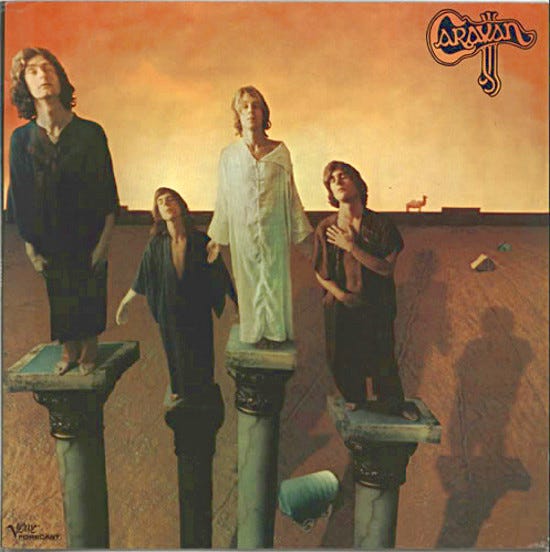
The cover captures this visually. The four band members appear elevated and slightly absurd, staged between earth and sky, theatrical but not grand. They look neither like prophets nor clowns, though something of both is present. The image has a strange late-day glow, as if the official business of the world has ended and some private ceremony has begun after hours. It is not mystical enough to be solemn and not comic enough to be dismissed. That ambiguity is very close to the music.
Caravan are above the ground, but not free of it. They are reaching toward another register while still casting ordinary shadows. The dream has not escaped the courtyard. The courtyard has simply become strange enough to hold the dream.
That may be the best way to enter this record. It should be heard as a band measuring the dimensions of its own interior space. The walls are unfinished. The wiring is exposed. Some circuits hum more reliably than others.
But the first signal is passing.
And once the signal is passing, the rest becomes possible.
