

Affinity – Affinity (1970)
The Cold Water Still Runs

Some records enter your life as events. Others arrive quietly, long after the official map has already been drawn.
Affinity’s 1970 debut belongs to that second category for me. It is one of those Vertigo records that seemed to be waiting at the edge of the story: the swirl label, the Marcus Keef sleeve, the strange mixture of jazz, blues, psychedelia, soul, and early progressive ambition, all preserved inside one of those short-lived British underground careers that left behind just enough evidence to become mysterious.
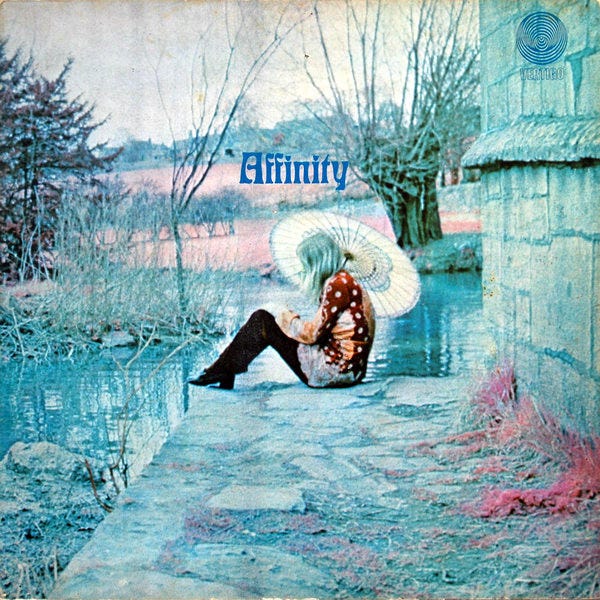
I came to it late. Very late, really. Probably only about two years ago. By that point I had already spent years working through the familiar monuments of progressive rock, and then further outward into the smaller rooms: Vertigo, Neon, Dawn, Deram, RCA oddities, private pressings, one-album bands, records that never became institutions but never quite disappeared either.
That road less traveled has become one of the great pleasures of this writing project. Not because obscurity itself makes music better, but because the official story is always incomplete.
With Affinity, there was another complication. I had already come to Linda Hoyle from the other direction. Pieces of Me had already been part of my listening and writing life sincce childhood, so this was not my first encounter with her voice. In a strange way, I had heard the downstream consequence before fully sitting with the source.
Even so, I initially hesitated.
The reason was simple: “All Along the Watchtower.”
That title on a track list can make me cautious. Dylan’s song had already become something larger than a song. Hendrix had already transformed it into weather, electricity, battlefield, prophecy. By 1970, covering “All Along the Watchtower” was not simply an act of repertoire. It was an act of comparison. And comparison, especially against a version that had already rewritten the meaning of the original, can be fatal.
But I have learned, slowly, that early progressive and heavy psychedelic bands often used covers differently. They were not always padding out an album. They were stress-testing material. They were taking known structures and placing them under altered pressure. Vanilla Fudge did this. Deep Purple did this. Flower Travellin’ Band did it almost as a manifesto. A cover could become a diagnostic instrument: feed a known signal into a different circuit and listen to what the system reveals.
That is the key to Affinity.
This is not an album weakened by borrowed material. It is an album partly about borrowed material. Of the seven tracks, only “Night Flight” and “Three Sisters” are Affinity originals. The rest are transformations: Alan Hull, the Everly Brothers, Annette Peacock, the Lovin’ Spoonful, Bob Dylan. In weaker hands, that might have made the record feel second-hand. Here, it becomes the argument. Affinity are not asking us to admire the purity of their authorship. They are asking what happens when songs already carrying cultural charge are passed through a band that has not yet settled into a single genre identity.
That makes the album feel very 1970.
Not finished. Not polished into category. Not yet prog in the later, heavier, more architectural sense. More like a system before final calibration: powered on, signal present, meters alive, drift visible, phase relationships still settling. You can hear the components finding their operating range.
And then there is the cover.
Marcus Keef’s image is one of the reasons the record lingers before the first note has even landed. A woman by cold water. Winter trees. A parasol. Pale blue saturation. Pinkish frost. The Vertigo swirl hovering like a signal from some separate optical machine. It is pastoral, but not warm. Psychedelic, but not flamboyant. English, but not cozy.
The surface looks frozen.
But the water is still moving.
That is the album’s thesis. Stillness on the surface, motion underneath. A record that often feels cool, controlled, almost misted over, while the internal current keeps shifting. Jazz moving beneath rock. Blues moving beneath arrangement. Female presence moving through a genre that too often wrote women into its margins. Covers moving through original identity. The past moving through the future before anyone has agreed what the future is going to be called.
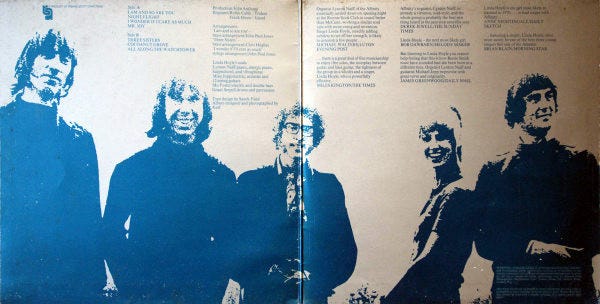
Side A: Calibrating the Signal
“I Am and So Are You” is a superb opening because it does not begin by creeping in. It arrives with weight: organ, guitar, brass, rhythm section, Linda Hoyle already centered in the field. The brass arrangement gives the track a bright, almost declarative edge, but it does not turn the song into simple uplift. There is too much density in the sound for that. The music has punch, but also friction.
The title sounds like communal affirmation — I am, and so are you — but by 1970 that kind of affirmation had already become more complicated. The late sixties had promised forms of liberation that the early seventies were beginning to audit. The dream of the shared self, the collective awakening, the dissolution of old social categories: all of that was still present, but the invoice had arrived. The culture was less innocent now. The song’s declaration no longer feels like a slogan. It feels like something that has to be asserted because it is no longer guaranteed.
What Affinity do musically is important. They take Alan Hull’s song and pass it through a larger gain stage. The brass hits act almost like transient spikes: brief injections of force that sharpen the edges without overwhelming the central signal. Lynton Naiff’s organ supplies mass and heat. Mike Jopp’s guitar gives the sound bite and abrasion. Grant Serpell keeps the track moving with a jazz-rock looseness that prevents it from becoming stiff.
And Hoyle does something that becomes crucial to the whole record. She does not simply sing over the band. She sets the reference level.
That is where the calibration lens matters. In a badly staged recording, the vocal is either buried in the noise floor or pushed into clipping. Here, Hoyle occupies the exact place the music requires. She has power, but she does not use power as blunt force. She controls overload. When the band thickens around her, she does not compete by shouting. She adjusts the emotional gain so that the listener’s ear keeps returning to her as the center of stability.
That is what makes her so important to Affinity. She is not decoration. She is not a guest color placed against male instrumental seriousness. She is the calibration point. The band can move outward because her voice keeps telling us where zero is.
“Night Flight,” one of the two originals, is where the album begins to stretch. The title is already perfect for this band: motion through darkness, travel without full visibility, progress by instrument rather than by sight. The track does not behave like a simple blues-rock extension. It moves through sections, with the rhythm and organ work suggesting a group testing how far they can move away from song form without losing the listener.
